


The cash flow hit most employers haven’t modelled yet.
When Class 1A NIC moves to real-time payment in 2027, one specific month creates a double liability most finance teams haven’t planned for. Here’s the maths.
What Class 1A NIC actually is, a quick refresher
Class 1A NIC is the employer-only contribution charged on most benefits-in-kind company cars, private medical insurance, gym memberships, the works. Currently it’s calculated annually, declared on the P11D(b), and paid by 22 July following the end of the tax year. The current rate is 15%.
So if you provided £50,000 worth of taxable benefits across your workforce in 2025/26, your Class 1A bill due 22 July 2026 is £7,500. One number, one payment date, once a year. Predictable, even if the amount itself can sting.
The old rhythmBenefits provided across a full tax year (April to April) → calculated and declared by 6 July → Class 1A NIC paid by 22 July. One liability event, fifteen months after the earliest benefits in that year were actually provided. Slow, but simple to budget for. |
The shift to real-time payment
From 6 April 2027, this changes for Phase 1 benefits company cars, vans, fuel, and medical insurance. Instead of one annual Class 1A NIC bill, you pay it through your payroll, alongside every other payroll liability, each pay period. No more single July payment. Instead, twelve (or however many pay periods you run) smaller payments spread across the year.
On paper, that actually sounds better for cash flow. Smaller, regular payments instead of one large annual hit that’s generally easier to manage than a lump sum. And for ongoing years, once the system has settled, it genuinely is smoother.
“Real-time Class 1A sounds like an improvement, and for year two onwards, it is. It’s the transition year that creates the problem.”
The transition year is 2027/28. And here’s the bit that catches people out: the move to real-time payment doesn’t erase the liability that built up under the old system. It just changes how future liabilities get paid. The old liability still has to be settled on the old timetable.
The double-liability month and why it catches finance teams out
Walk through the calendar with me. Your 2026/27 tax year, the last full P11D year for Phase 1 benefits, runs April 2026 to April 2027. Under the old system, the Class 1A NIC for that entire year is due by 22 July 2027.
At the same time, your 2027/28 tax year has already started on 6 April 2027. From that date, you’re paying Class 1A NIC in real time, through payroll, on your 2027/28 benefits. By July 2027, you’ll have already made three months of real-time Class 1A payments for the new year.
The collision, in plain termsIn July 2027, you will owe Class 1A NIC for the entirety of 2026/27 (paid as a lump sum, old system) while simultaneously having already paid three to four months of Class 1A NIC for 2027/28 (paid in real time, new system). For a business with a stable or growing benefits package, July 2027 effectively becomes a 15-month Class 1A NIC liability landing in roughly a 12-month cash flow window. |
If your July payment run suddenly needed to cover an extra few months of National Insurance on top of what you’d normally pay, would your business notice? Would it actually hurt?
Visualising the cash flow gap
Numbers are easier to feel in a chart. Here’s a simplified picture for a business with a stable £80,000 annual Class 1A liability, showing what a normal year looks like versus the transition year.
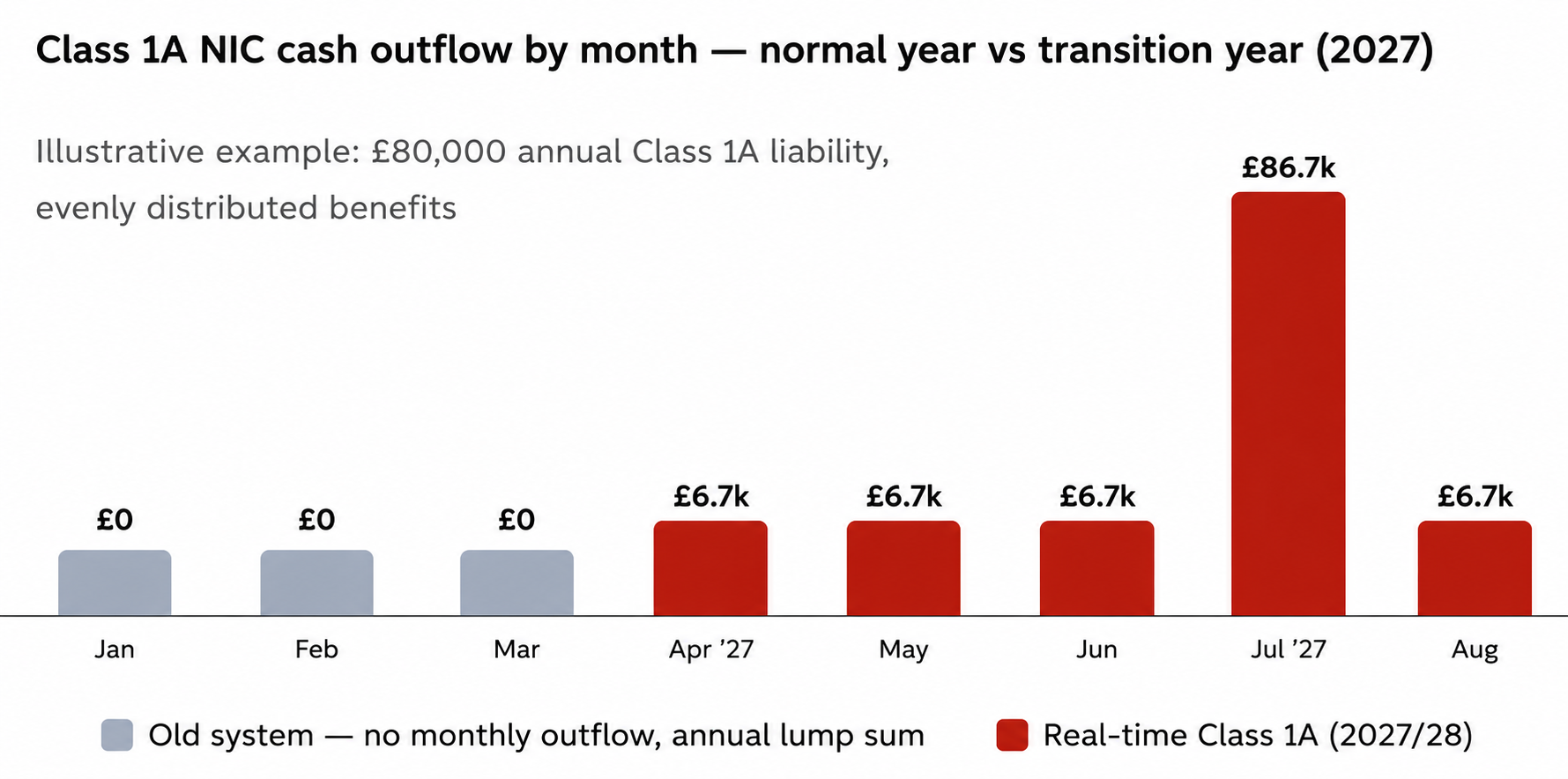
That spike in July isn’t a typo. It’s the full £80,000 owed for 2026/27 under the old system, landing in the same month as your third real-time payment of roughly £6,700 for 2027/28. One month, nearly £87,000, where a normal month would see roughly £6,700 or, under the old system, nothing at all outside of July.
Estimate your own exposure
Put your own numbers in. This gives a rough sense of what your July 2027 might look like.
Class 1A Transition Exposure Estimator
A rough guide only talk to your accountant for an exact figure based on your benefits structure
Annual taxable value of Phase 1 benefits (cars, vans, fuel, medical)…………………£9000
Months of real-time Class 1A already paid by July 2027………………………..……..……£3
2026/27 Class 1A due (old system, lump sum)……………………………………………………£1,350
2027/28 Class 1A already paid (real-time, est.)…………………………………………………..£338
Combined July 2027 exposure…………………………………………………..……………………….£1,688
Calculated at the current Class 1A NIC rate of 15%. This assumes a stable benefits value year on year growing benefits packages will see a larger gap.
How to actually manage this
Honestly, the fix here isn’t complicated it just requires starting early, which is the part most businesses get wrong with any future-dated liability. Here’s what we’re telling clients.
|
Don’t do this |
Do this |
|
|
Example
A logistics client of ours runs a fleet of around 60 company vehicles, which meant their Class 1A liability on car and fuel benefits alone was substantial. When we ran the transition model for them in early 2026, the projected July 2027 figure was high enough that their finance director asked us to repeat the calculation twice, assuming we’d made an error.
We hadn’t. The number was genuinely that much higher than their normal July payment, purely because of the old-system-meets-new-system overlap. We worked with them to set up a monthly cash reserve building through 2026/27, specifically earmarked for the transition month, so the July 2027 payment wouldn’t disrupt their normal working capital. That’s the kind of planning that needs a year of runway, not a few weeks.
|
Example The businesses who handle this well aren’t necessarily the largest ones they’re the ones who treat tax transitions as finance planning issues rather than compliance admin. A £40,000 benefits package and a £400,000 one face the same structural problem, just at different scales. Model it now regardless of your size. |
The Final verdict
Here’s what most people miss about this whole transition: the policy intent is genuinely sound. Real-time Class 1A payment, once it’s bedded in, spreads a previously lumpy annual cost across the year, which is better cash flow management in the long run for most businesses.
But policy good sense and transition mechanics are two different things. HMRC’s phased approach has bought employers extra time on the operational side software, employee comms, benefit categorisation. It hasn’t changed the fundamental arithmetic of the transition month, because the old liability for 2026/27 still has to be paid on the old schedule regardless of how the new system is rolled out.
The bottom line
If you provide company cars, vans, or medical benefits to your employees, July 2027 is going to be an unusually expensive month, and you have roughly a year to prepare for it. That’s enough time to build a cash reserve, adjust your working capital planning, and avoid a genuine liquidity scare. It is not enough time if you start thinking about it in June 2027.
This is exactly the kind of thing that gets buried under the more visible parts of a tax transition software updates, payslip changes, employee questions. All real, all important. But none of them will hurt your business the way an unplanned six-figure cash outflow can. Get your finance team modelling this now, not when HMRC sends the reminder.
Need an exact figure for your business? Talk to SKZ Accountants.
We’re specialist accountants in Ilford helping UK employers model their Class 1A NIC transition exposure, build cash reserve strategies, and prepare for the move to real-time payrolling of benefits.
Contact us! For CFO Services, Payroll Bureau Services, Accountants in Croydon, Accountants in Essex, CIS Accountants, Accountants in Brentwood, Accountants in Central London, Accountants in Barking, Accountants in Canary Wharf, Accountants in Romford, Accountants in Stratford, Accountants in Ilford, Practical Accounting Training in UK, Accountants in Liverpool Street, Accountants in NewHam, and Accountants in Middlesbrough.